
To improve sandy, rocky soil in the Inland Northwest, remove large surface rocks, loosen the planting zone, and incorporate 1 to 3 inches of finished compost into the upper 6 to 8 inches of soil. Compost does not change the soil’s mineral texture, but it can improve moisture retention, nutrient availability, aggregation, and biological activity. New lawns may perform better when a nutrient-rich soil and compost blend is installed before seed or sod, creating a deeper and more consistent root zone.
Growing a lush lawn or productive garden in the Inland Northwest often begins with ground that looks more like construction fill than fertile soil. Properties around Rathdrum, Post Falls, Coeur d’Alene, Liberty Lake, and Spokane Valley may contain sand, gravel, cobbles, compacted subsoil, or thin layers of usable topsoil.
At Alpine Bark Blowing, we help homeowners and contractors rebuild these difficult growing areas with compost, screened topsoil, planting soil, and premium soil blends.
Why Inland Northwest Soil Can Be Difficult to Grow In
The Spokane Valley and Rathdrum Prairie sit over deposits created by ancient glacial floods. The underlying material includes coarse sand, gravel, cobbles, and boulders, which explains why some properties drain quickly and contain large quantities of rock. Local conditions still vary by site, so one yard may have loose gravel while another contains finer soil, clay pockets, or compacted imported fill.
Sandy soil contains large pore spaces that allow water to move through quickly. That fast movement can leave the root zone dry and make nutrients more difficult to manage. Washington State University notes that sandy soils commonly require more frequent watering and lighter, more frequent fertilization.
Rocky soil creates another challenge. Large stones reduce the volume of soil available for roots and make grading, planting, and even moisture distribution less consistent.
Common warning signs include:
- Water disappearing immediately after irrigation
- Plants wilting soon after watering
- Grass turning brown during summer
- Shallow or restricted root growth
- Seedlings that establish unevenly
- Fertilizer producing only temporary improvement
- Rocks continually rising through the lawn surface
How Compost Improves Sandy, Rocky Soil
Anyone researching how to improve sandy rocky soil should focus on building organic matter rather than trying to remove every stone or replace the entire yard.
Finished compost helps bind mineral particles into more stable aggregates. These aggregates create a healthier balance of pore spaces, allowing sandy soil to retain more moisture while supporting air movement and microbial activity. Compost also returns organic material and plant nutrients to depleted ground, although exact nutrient levels depend on the finished product.
Our soil and compost products include several options for different projects:
- Ultra Fine Soil Builder for adding finely screened organic material
- Screened Topsoil 50/50 Blend for leveling and rebuilding landscape areas
- All-Purpose Planting Soil for trees, shrubs, perennials, and new beds
- Premium Garden and Raised Bed Mix for vegetables and flowers
- Premium Lawn and Garden Soil blended with 33 percent Barr-Tech compost
- Barr-Tech BT Green Compost for direct soil amendment
These materials allow us to match the amendment to the existing soil rather than applying one product to every property.
A Practical Plan for Amending Soil With Compost
1. Test and Inspect the Existing Soil
Begin with a soil test to identify pH, organic matter, and nutrient needs. Dig several small inspection holes to see how deep the usable soil extends and whether the lower layer contains sand, cobbles, clay, or compacted construction fill.
2. Remove Problem Rocks
Small gravel can remain when it does not interfere with grading or planting. Remove larger rocks from the upper root zone, especially where sod, seed, vegetable roots, or new trees will be installed.
3. Loosen Compacted Ground
Break up compacted soil before adding compost. Working new material only into the surface can create a thin growing layer over a hard barrier.
Avoid pulverizing wet soil or repeatedly driving equipment over the prepared area.
4. Incorporate the Correct Amount
For many new planting areas, WSU guidance recommends applying 1 to 3 inches of organic amendment and mixing it into at least the upper 6 to 8 inches. More is not automatically better because excessive compost can create nutrient and water-quality concerns.
5. Protect the Surface
After planting, cover nearby landscape beds with organic bark mulch. Mulch reduces evaporation, buffers soil temperature, and protects exposed ground from erosion.
Preparing Rocky Soil Before Seed or Sod
A new lawn is only as strong as the root zone beneath it. Spreading seed over gravelly fill or laying sod on a thin layer of loose topsoil may create green results at first, followed by drought stress and thinning grass.
For long-term performance, the lawn area should be:
- Cleared of debris and large rocks
- Graded for drainage
- Loosened below the finish surface
- Covered or amended with nutrient-rich soil and compost
- Lightly compacted to reduce later settling
- Finished smooth before seeding or laying sod
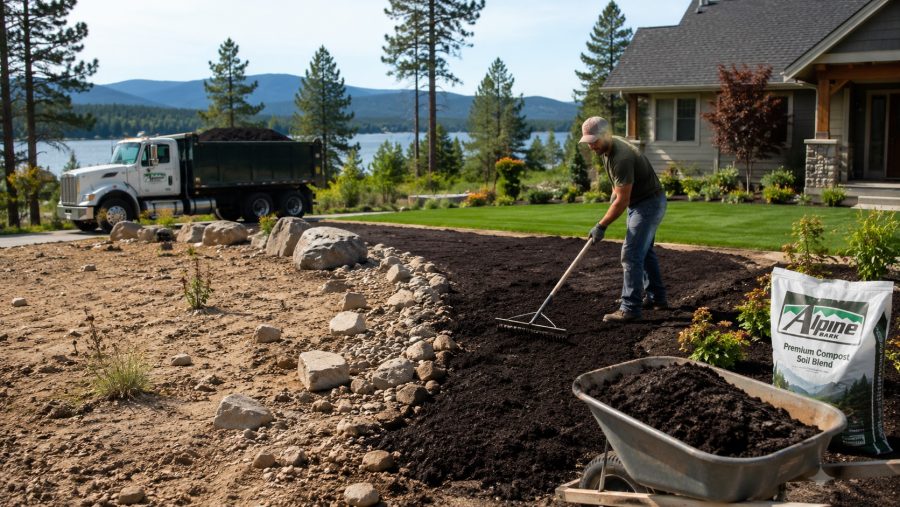
Our blower equipment can install lawn and garden soil or Barr-Tech compost across large or difficult-to-access areas. This helps create consistent coverage without repeated wheelbarrow traffic over the prepared subgrade.
Bulk Organic Compost Delivery Across the Inland Northwest
Large lawn and garden projects often require several cubic yards of material. Alpine Bark Blowing offers pickup, professional installation, and bulk organic compost delivery from our Hauser location.
We serve communities throughout North Idaho and Eastern Washington, including Coeur d’Alene, Post Falls, Hayden, Spokane, Spokane Valley, Liberty Lake, Airway Heights, Deer Park, Mead, and surrounding areas.
Use our yardage calculator to estimate the required amount based on length, width, and application depth.
Turn Dry Dirt Into a Productive Root Zone
Successful amending soil with compost is not about hiding poor ground under a thin dark layer. The goal is to build a deeper, more stable root zone that holds moisture, supports soil organisms, and gives plants access to nutrients.
Homeowners searching for a topsoil and compost mix near you can contact Alpine Bark Blowing for help selecting the right blend, calculating yardage, and arranging delivery or blower installation.
Frequently Asked Questions
How much compost should be added to sandy soil?
For a new garden or landscape area, 1 to 3 inches incorporated into the upper 6 to 8 inches is a common starting range. Use a soil test to avoid unnecessary overapplication.
Can compost remove rocks from soil?
No. Large rocks must be removed mechanically. Compost improves the usable soil around remaining mineral material.
Should compost be placed under new sod?
Compost or a compost-enriched soil blend can be incorporated before final grading. Sod should rest on a smooth, firm, well-prepared root zone rather than loose compost alone.