
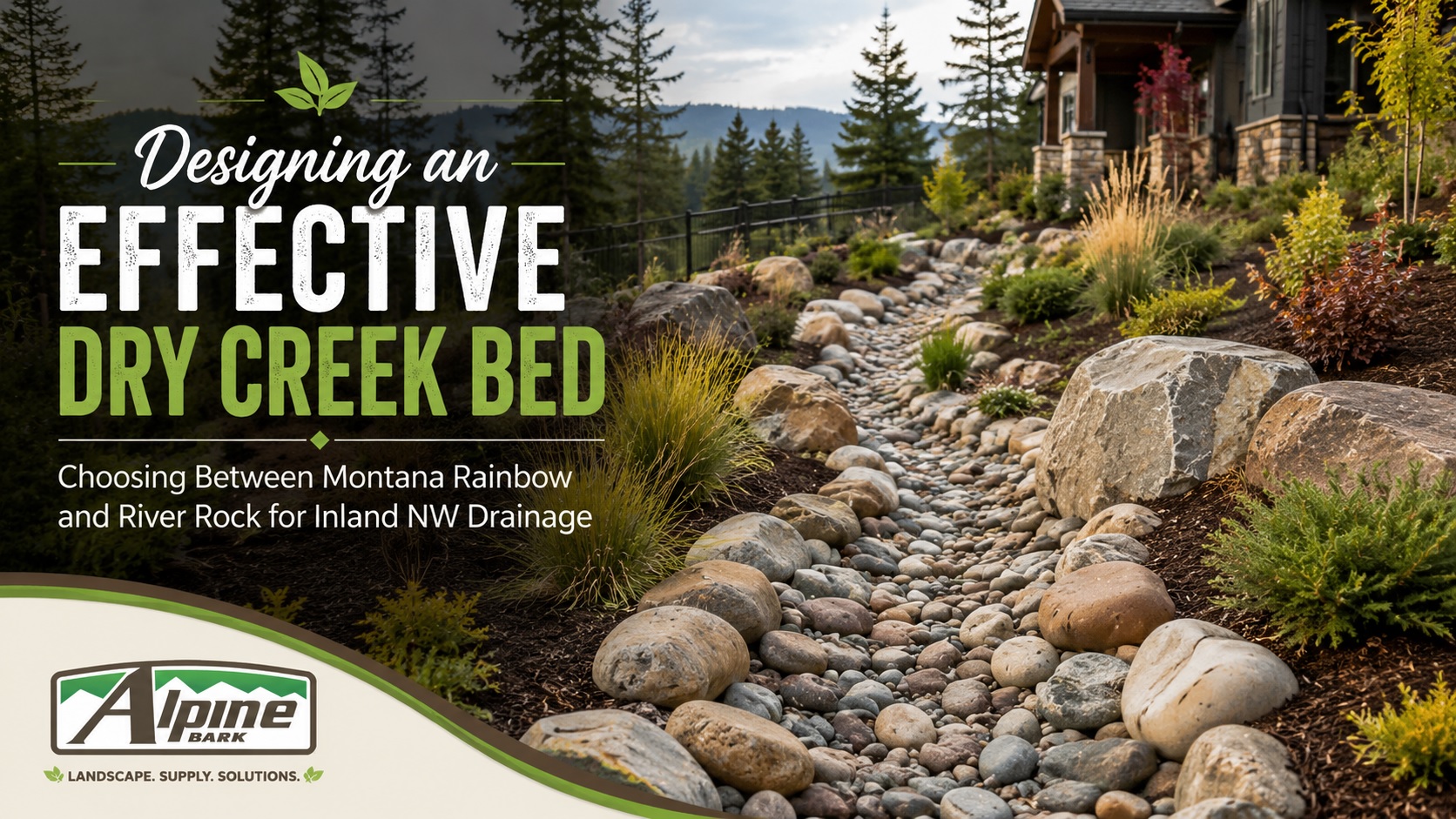
A dry creek bed works best when smooth, rounded rock is layered by size. Use 1 1/2″ to 4″ River Rock or Montana Rainbow Rounds through the main flow channel, then anchor the banks with larger 3″ to 9″ Montana Rainbow Rounds where seasonal runoff is strongest. Rounded stones help water move naturally through the channel, while angular rock is better suited for high-traction pathways and stable walking surfaces.
Why Dry Creek Beds Work in the Inland Northwest
In Coeur d’Alene, Hauser, Post Falls, Hayden, Liberty Lake, and the wider Inland Northwest, drainage issues often show up as muddy low spots, eroded mulch beds, washed-out slopes, or runoff that cuts across lawns after heavy rain or snowmelt.
A dry creek bed solves that problem with structure and style. Instead of letting water carve its own path, the channel gives runoff a controlled route. When built correctly, it protects soil, reduces mud, and adds a natural stone feature that looks intentional even when dry.
At Alpine Bark Blowing, our team helps homeowners and contractors choose dry creek bed rocks that balance drainage performance with curb appeal.
Montana Rainbow vs. River Rock
Both Montana Rainbow and River Rock can work beautifully in a dry creek bed, but they create different visual effects.
River Rock has a timeless, natural look. Its smooth, rounded surface helps water move through the channel without catching as aggressively as angular stone. This makes it a strong choice for base flow areas, water features, and broad drainage swales.
Montana Rainbow Round has a more decorative color blend. It brings earthy tones, contrast, and a higher-end finish to visible beds near patios, entries, and landscaped borders. The larger 3″ to 9″ Montana Rainbow Rounds are especially useful for anchoring creek banks and creating natural-looking bends.
The Right Rock Sizes for Drainage
A dry creek bed should not be filled with one size of rock. Nature does not build streams that way, and neither should a designed drainage channel.
Use this structure as a practical guide:
| Creek Bed Zone | Recommended Rock | Purpose |
|---|---|---|
| Main flow channel | 1 1/2″ to 4″ River Rock or Montana Rainbow Rounds | Moves water and protects the base |
| Creek edges and bends | 3″ to 9″ Montana Rainbow Rounds | Anchors banks and handles stronger runoff |
| Decorative upper banks | Smaller Montana Rainbow or mixed rounds | Blends the feature into the landscape |
| Pathway crossings | Angular rock or pavers | Adds traction where people walk |
The larger stones belong where water pressure is highest: curves, downspout discharge points, slope transitions, and lower collection areas.
Rounded Rock vs. Angular Rock
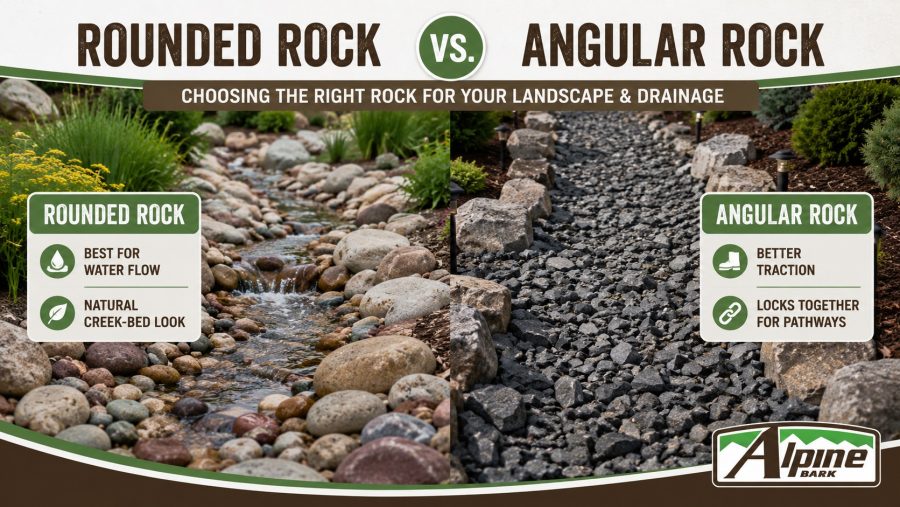
Rounded dry creek bed rocks are preferred for drainage channels because they look water-worn and allow runoff to weave through the stone bed naturally. The smooth profile also creates the visual effect of a real creek, even when the channel is dry.
Angular rock has a different purpose. It locks together more tightly, which helps on walkways, utility paths, and places where traction matters. Angular Clean Basalt, for example, can provide a stable surface where foot traffic is expected, while rounded river rock is better for the drainage path itself.
How to Estimate Rock Volume
Before ordering, calculate the channel length, average width, and installation depth. For most decorative dry creek beds, depth can vary by function. Shallow decorative edges may need less material, while active drainage channels and deeper swales require more.
Use Alpine Bark’s Yardage Calculator to estimate bulk material needs before scheduling pickup or delivery. A drainage rock calculator helps avoid two common problems: underordering, which leaves thin areas exposed, and overordering, which creates extra piles on the property.
Design Tips for a Natural Dry Creek Bed
A convincing dry creek bed should curve gently, widen in collection zones, and narrow where water is meant to move faster. Avoid a perfectly straight trench unless the site requires a utility-style drainage swale.
Build the bed with these details:
- Shape the channel to guide water away from structures.
- Use landscape fabric where appropriate to reduce soil migration.
- Place larger stones first at bends and banks.
- Fill the center with 1 1/2″ to 4″ rounded rock.
- Blend the edges with plants, bark, boulders, or decorative stone.
- Keep mulch and loose soil away from the active water path.
For properties with steep slopes or hard-to-reach beds, our bark blowing service can help finish surrounding areas cleanly after rock and drainage work are complete.
Landscaping Rock Coeur d’Alene Property Owners Can Use With Confidence
A dry creek bed should do more than look nice after installation. It should withstand seasonal runoff, reduce erosion, and fit the surrounding landscape. Alpine Bark Blowing supplies decorative rock, bark mulch, soil, compost, sand, gravel, and bulk landscape materials for residential and commercial projects across North Idaho and Eastern Washington.
From lakeside Coeur d’Alene properties to Post Falls, Hayden, Hauser, Liberty Lake, Spokane Valley, Sandpoint, and surrounding communities, our team helps match the right material to the drainage problem.
Work With Alpine Bark Blowing
Choosing the right river rock landscaping near me starts with the channel design. Use rounded River Rock or Montana Rainbow through the flow path, anchor the banks with larger rounds, and calculate material depth before ordering.
Contact Alpine Bark Blowing for decorative rock, dry creek bed rocks, delivery, pickup, and bulk landscape supply support across the Inland Northwest.