
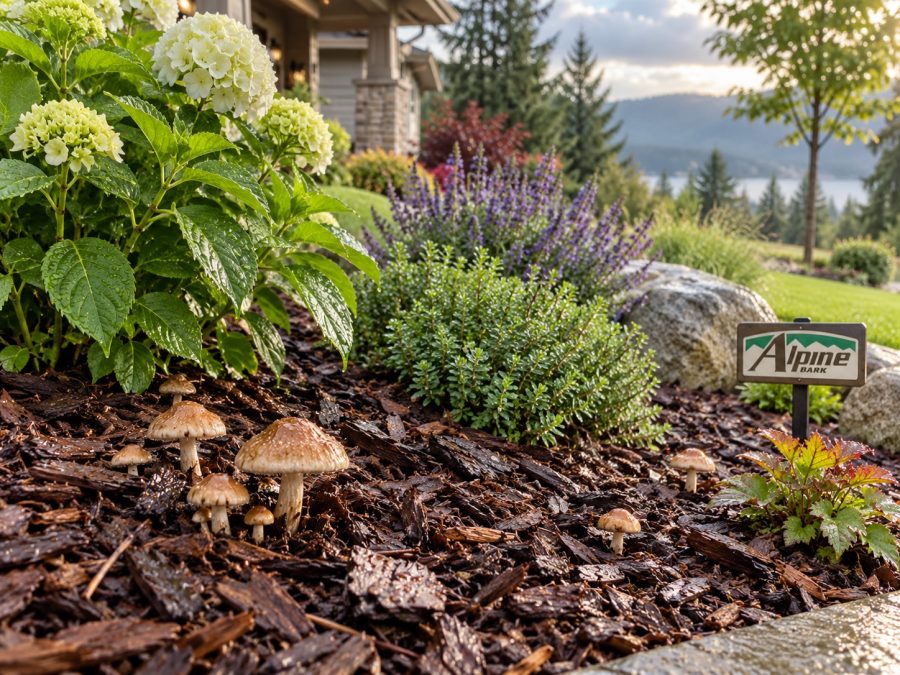
Mushrooms commonly appear in bark mulch because fungi naturally help break down wood and other organic material. Rain, irrigation, shade, and consistently moist bark can make mushrooms more visible. In most cases, they do not harm trees, shrubs, or flowers. They can be removed for appearance or where pets and children may investigate them, but replacing the entire mulch bed is rarely necessary.
Seeing mushrooms suddenly pop up in a bark bed can make a healthy landscape look like something has gone wrong.
In most cases, the opposite is true.
At Alpine Bark Blowing, we view mushrooms in mulch as part of the natural decomposition process. Bark is organic material, so fungi and other organisms gradually break it down over time.
The important question is not whether fungi exist in the mulch. It is whether moisture, mulch depth, drainage, or plant health suggests a separate landscape problem.
Why Do Mushrooms Grow in Bark Mulch?
Bark contains organic material that fungi can use as a food source.
As bark decomposes:
- Fungi begin colonizing the wood and bark.
- Most fungal activity remains hidden inside the mulch.
- Moist conditions encourage reproductive structures to develop.
- Those visible structures appear as mushrooms.
The mushroom is usually only the visible portion of a much larger fungal network breaking down organic material.
Penn State Extension notes that fungi and bacteria are major organisms involved in decomposing wood and bark mulch. That decomposition is a normal part of what happens to organic mulch outdoors.
Why Do Mushrooms Appear After Rain?
Mushrooms often seem to appear overnight because moisture creates favorable fruiting conditions.
Common triggers include:
- Several rainy days
- Spring snowmelt
- Frequent irrigation
- Cool, damp weather
- Shaded landscape beds
- Moisture held inside organic bark
That is especially relevant in North Idaho, Coeur d’Alene, Post Falls, Hayden, Rathdrum, and the Spokane Valley area.
A bark bed may remain relatively dry for weeks, then suddenly develop mushrooms after a stretch of rain or cooler weather.
That does not necessarily mean the mulch suddenly became defective.
Are Mushrooms in Mulch Bad for Plants?
Usually, no.
Many mushrooms found in landscape bark are decomposers. They feed on dead organic material rather than healthy shrubs, flowers, or trees.
Oregon State University Extension similarly explains that fungi responsible for mushrooms in organic mulch are generally part of the decomposition process and are not harmful to landscape plants.
As bark breaks down, that process can eventually contribute organic material back into the soil.
There is one important distinction. If nearby plants also show rot, dieback, soft stems, root problems, or serious decline, the plant itself should be evaluated separately.
Not every fungus in every landscape situation is identical.
Does Fungus Mean the Mulch Is Bad?
No. Fungal growth does not automatically mean bark mulch is contaminated, defective, or unusable.
Organic bark is supposed to decompose gradually.
That natural breakdown is part of the reason bark works well in landscape beds while helping conserve moisture, moderate soil conditions, and suppress weeds.
A few mushrooms after wet weather generally do not justify removing otherwise healthy bark.
Can Too Much Moisture Encourage Mushrooms?
Yes.
Mushrooms can become more noticeable when bark remains consistently wet because of:
- Excess irrigation
- Sprinkler overspray
- Poor drainage
- Heavy shade
- Excessive bark depth
- Bark piled tightly around plants
- Extended rainy weather
However, a few mushrooms after natural rainfall do not prove that the bed is being overwatered.
We look for a pattern of persistently soggy conditions.
Can Mulch Be Too Deep?
Yes. Bark that is piled excessively deep can hold more moisture than necessary and reduce airflow around plant crowns and trunks.
For many landscape beds, we recommend maintaining roughly a 3-inch layer rather than continually adding fresh material without checking how much bark is already there.
Our guide to proper bark mulch depth explains why depth affects weed suppression, moisture retention, root insulation, and long-term bed performance.
The goal is enough bark to perform well without creating an unnecessarily wet layer.
Mushrooms vs. Slime Mold vs. Other Mulch Fungi
Not everything that appears on mulch is a typical mushroom.
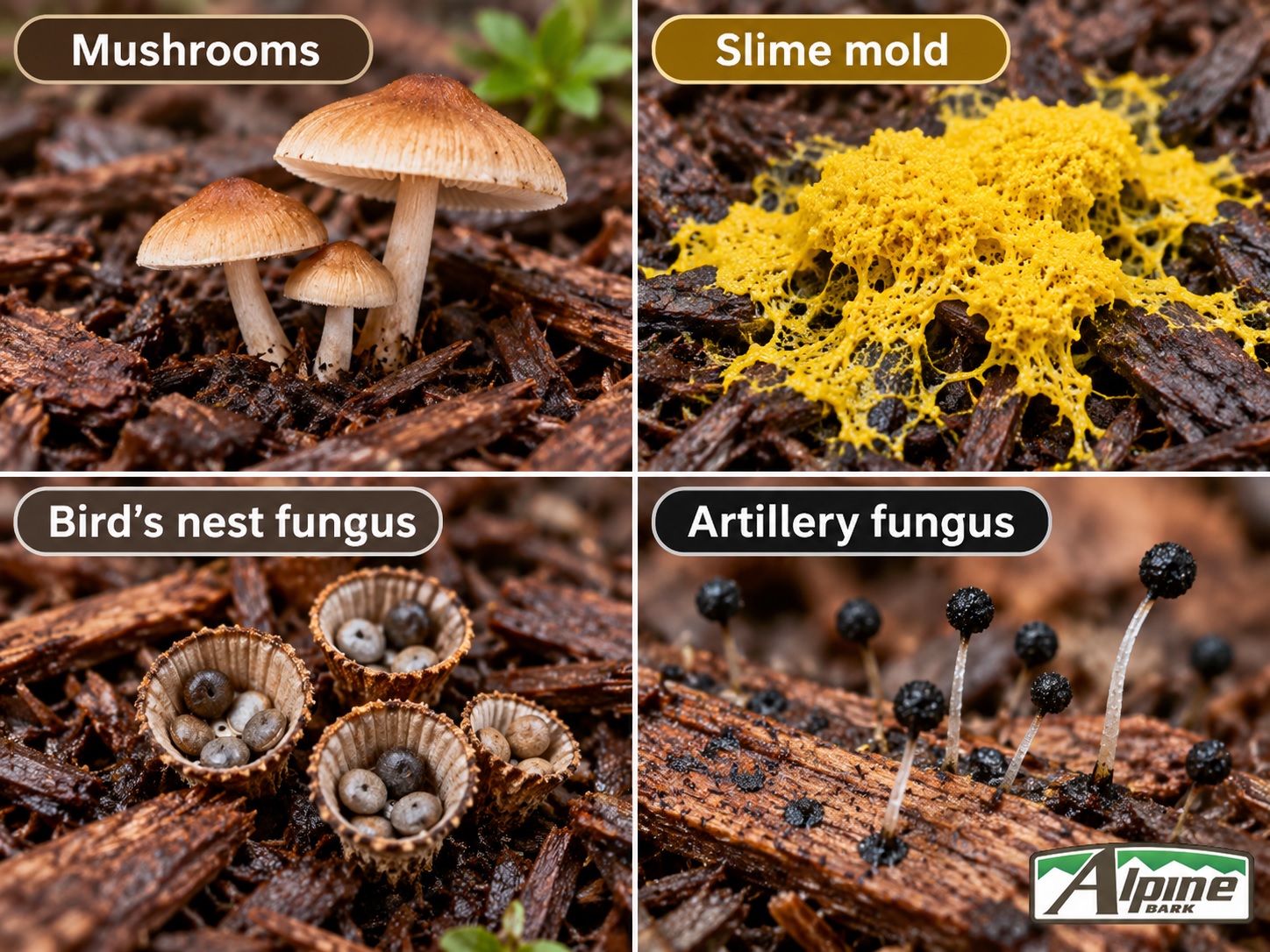
| Growth | Typical Appearance | Usually Harmful to Plants? | Typical Response |
|---|---|---|---|
| Mushrooms | Caps and stems | Usually no | Leave or remove for appearance |
| Slime mold | Foamy, crusty, yellow, gray, or brown mass | Usually no | Let dry or remove |
| Bird’s nest fungus | Tiny cups resembling nests with eggs | Usually no | Usually no treatment needed |
| Artillery fungus | Tiny fruiting bodies that eject dark spores | Usually not a plant problem | Manage mulch conditions and protect nearby surfaces |
Slime Mold
Slime mold can look dramatic. Some forms resemble bright yellow foam, spilled paint, or crusty material spread over the mulch.
It is usually temporary and more of an appearance issue than a plant-health problem.
Bird’s Nest Fungus
Bird’s nest fungi produce tiny cup-shaped structures containing small objects that resemble eggs.
They are common decomposers in landscape mulch.
Artillery Fungus
Artillery fungus deserves a little more attention because it can eject sticky dark spores onto siding, fences, vehicles, and other light-colored surfaces nearby.
It is still different from a disease attacking landscape plants.
Should We Remove Mushrooms From Mulch?
Removal is optional in most cases.
Mushrooms can usually be left alone and allowed to disappear naturally.
We may recommend removing visible mushrooms when:
- Appearance is a concern
- They are growing along walkways
- Pets investigate the bed
- Young children use the area
Raking or picking up the visible fruiting bodies is generally enough for appearance.
One safety rule matters:
Never eat an unidentified mushroom growing in a landscape bed.
Appearance alone is not a reliable way to determine whether a mushroom is safe.
How to Reduce Mushrooms in Bark Mulch
If mushrooms are appearing repeatedly, focus on the conditions that keep the bark wet.
1. Remove Visible Mushrooms
Pick up or rake out mushrooms if they are unwanted.
2. Check Irrigation
Make sure sprinklers are not soaking bark beds more often than the plants require.
3. Improve Drainage
Address areas where water continually pools or drains into the planting bed.
4. Maintain Proper Bark Depth
Avoid stacking new layers over old mulch without checking the existing depth first.
5. Keep Bark Away From Trunks and Stems
Leave breathing space around tree trunks, shrub stems, and plant crowns rather than piling wet bark against living tissue.
6. Remove Excess Debris
Thick leaf buildup and other organic debris can hold moisture on top of bark.
7. Improve Airflow Where Practical
Very dense plantings and continually shaded spaces may stay damp longer.
Should Mushroom-Covered Mulch Be Replaced?
Usually not.
Replacement may make sense when the bark is already heavily decomposed, compacted, too deep, or near the end of its useful service life.
We may also refresh a bed when drainage corrections or landscape improvements require rebuilding the area.
What we would not recommend is replacing fresh, properly installed bark simply because mushrooms appeared after rain.
What If Mushrooms Keep Coming Back?
Repeatedly removing mushrooms does not eliminate the fungal network living within organic bark and soil.
That is neither practical nor necessary.
Instead, check:
- Irrigation
- Drainage
- Mulch depth
- Shade
- Leaf accumulation
- Age of the bark
The goal should be healthy landscape conditions, not trying to sterilize an outdoor bark bed.
Healthy Bark Beds Need the Right Balance
Mushrooms can look alarming, but most are simply taking advantage of moist organic material while bark naturally decomposes.
A healthy bark bed depends on the right balance of quality bark, proper depth, even application, appropriate irrigation, good drainage, and space around plants.
Alpine Bark Blowing provides bark products, professional bark blowing, pickup, delivery, and bulk landscape materials throughout North Idaho and the Spokane-area corridor.
Schedule bark blowing or order bark for pickup or delivery when the landscape is ready for a properly installed refresh.
Frequently Asked Questions
Why are mushrooms suddenly growing in my mulch?
Fungi naturally decompose bark and wood. Visible mushrooms often appear when rain, irrigation, shade, or cool damp weather provides enough moisture for fruiting bodies to form.
Are mushrooms in bark mulch harmful to plants?
Usually not. Many fungi found in bark mulch are decomposers feeding on organic material rather than healthy landscape plants.
Should mushrooms be removed from mulch?
Removal is generally optional. They may be removed for appearance or when pets or children could try to eat them.
Does mushroom growth mean we are overwatering?
Not necessarily. Mushrooms commonly appear after natural rainfall. Repeated growth in consistently soggy beds may be a reason to check irrigation and drainage.
Can too much mulch cause fungus?
Excessively deep bark can hold additional moisture and create conditions favorable to fungal growth. Maintaining an appropriate bark depth helps balance moisture retention with airflow.
Will replacing the mulch get rid of mushrooms?
Not necessarily. Fungi occur naturally in soil and organic material. Correcting excessive moisture or excessive mulch depth is usually more useful than replacing otherwise healthy bark.