
You usually do not need to remove all old mulch before adding fresh bark. If the existing material is loose, partly decomposed, weed-free, and not already too deep, we can rake it out and add only enough new bark to restore the bed to about 2 to 3 inches total. Old mulch should be removed when it is matted, excessively deep, moldy, contaminated, or causing drainage and plant-health problems.
Refreshing mulch beds can make a landscape look new again, but adding fresh bark every year without checking what is already there can create problems.
At Alpine Bark Blowing, we focus on the total bark depth, not simply how much new material can fit on top.
Do You Need to Remove Old Mulch Before Adding New Bark?
Not usually.
Organic bark naturally breaks down over time. If the existing mulch has thinned, remains loose, and is in good condition, there is often no reason to haul all of it away.
Instead, we recommend:
- Pulling weeds.
- Removing leaves, branches, and unwanted debris.
- Loosening compacted or matted bark.
- Measuring the existing mulch depth.
- Adding only enough new bark to restore proper coverage.
Penn State Extension specifically recommends checking mulch depth before replenishing it and notes that repeated applications over old material can create the same problems as installing too much mulch at once.
Penn State Extension mulch guidance
When Can We Put New Mulch Over Old Mulch?
Adding fresh mulch over old mulch works well when the existing layer is:
- Partially decomposed
- Loose rather than heavily compacted
- Relatively clean
- Free of major weed growth
- Not piled against trunks or stems
- Thin enough that additional bark will not create excessive depth
For many North Idaho landscape beds, Alpine Bark recommends maintaining roughly 2 to 3 inches of total bark for reliable weed suppression, moisture retention, and root protection. Alpine Bark
The key word is total.
If 2 inches of usable bark are already present, adding another 3 inches creates a 5-inch layer. That can be much more material than the landscape needs.
When Should Old Mulch Be Removed?
Sometimes removal is the better option.
The Mulch Is Already Too Deep
Layering fresh bark year after year can gradually create an excessive mulch bed.
Too much material can retain excess moisture, restrict airflow around roots, and contribute to compaction. Alpine Bark’s guidance warns that excessively deep layers can create moisture and root problems.
The Old Mulch Has Become Matted
Fine bark can sometimes form a dense surface as it ages.
If water runs across the top instead of soaking through, break up the layer with a rake. Severely compacted material may need partial removal before the bed is refreshed.
Bark Is Piled Around Tree Trunks
Pull excess material away from tree trunks, shrub stems, and plant crowns.
We want bark covering the root zone, not pressed against living stems where moisture can remain trapped.
The Bed Contains Heavy Weed Growth
Do not simply bury established weeds under another load of bark.
Remove weeds and unwanted vegetation first. Alpine Bark’s bed-preparation guidance recommends clearing weeds and debris before new bark installation so they are not trapped underneath.
Drainage Problems Need Correction
If the bed remains waterlogged, adding more bark will not fix the underlying problem.
Drainage, grading, or irrigation may need attention before new material is installed.
Can Old Mulch Be Worked Into the Soil?
In established ornamental beds, we generally prefer leaving usable bark at the surface and allowing it to decompose naturally.
Older bark eventually becomes smaller and contributes organic material near the soil surface.
Aggressively digging bark into established shrub and perennial root zones is usually unnecessary just because the bed needs refreshing.
How Much New Bark Should We Add?
Start by measuring what remains.
Our goal is usually to bring the combined old and new layer back to the desired depth rather than placing a completely new 3-inch layer every season.
| Existing Bark | Typical Refresh Approach |
|---|---|
| Almost gone | Rebuild the layer to the target depth |
| About 1 inch | Add enough bark to restore coverage |
| About 2 inches | Light top-off may be enough |
| Already 3 inches | Usually no additional depth needed |
| More than 3 to 4 inches | Consider removing excess material |
For more detail on depth and weed control, see our guide to proper bark mulch depth.
How to Refresh Mulch Beds the Right Way
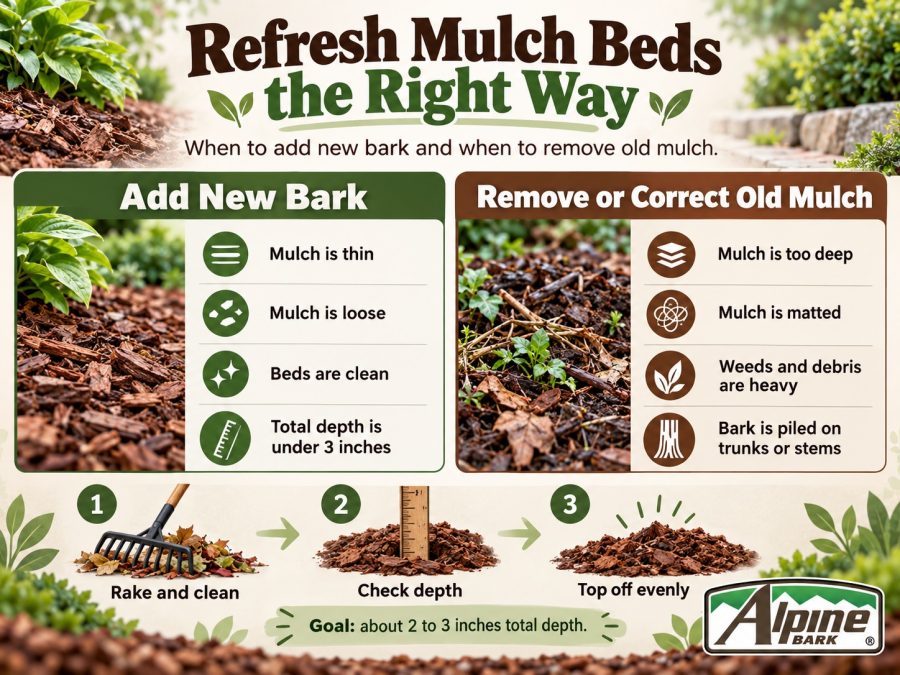
A good mulch refresh does not require stripping every bed to bare soil.
We recommend this process:
1. Clean the Bed
Remove weeds, fallen branches, matted leaves, and unwanted debris.
2. Loosen Existing Bark
Rake compacted areas so water and air can move through the layer more easily.
3. Check the Depth
Measure in several places rather than guessing from appearance.
4. Correct Edges and Plant Crowns
Pull bark back from trunks and stems and redefine bed edges where needed.
5. Add Only What Is Missing
Top off the bed until the desired total depth is reached.
6. Apply the New Bark Evenly
Professional bark blowing helps distribute material across large beds, slopes, narrow areas, and established landscapes without leaving large piles or uneven coverage.
Alpine Bark offers a range of bark mulch products for landscape beds, including fine bark options for refreshed residential and commercial landscapes.
Does Old Mulch Lose Its Benefits?
Yes, gradually.
As bark decomposes and thins, it provides less physical coverage for weed suppression, soil insulation, and moisture conservation.
Alpine Bark notes that bark installed around 2 to 3 inches deep commonly lasts about 2 to 3 years, although slope, traffic, exposure, and local conditions influence longevity.
That means a bed may need periodic topping off without requiring complete removal.
Refresh Mulch Beds Without Overdoing It
Fresh bark improves curb appeal, weed suppression, and moisture management, but more mulch is not automatically better.
Before adding new bark, we look at what is already in the bed.
If the old mulch is healthy and has simply thinned, keep it and add only what is needed. If it is excessively deep, compacted, contaminated, or contributing to drainage problems, remove or correct the problem areas first.
At Alpine Bark Blowing, we provide bark blowing, bulk bark, pickup, and delivery throughout North Idaho and the Spokane-area corridor.
Ready to refresh mulch beds? We can help determine the right amount of bark for a clean, even finish without unnecessary buildup.
Frequently Asked Questions
Should we remove old mulch every year?
No. Most usable organic bark can remain in place. Check its condition and depth before adding fresh material.
Can we put new mulch directly over old mulch?
Yes, when the existing bark is loose, clean, and not already too deep.
How much new bark should we add over old mulch?
Add only enough to restore the total layer to roughly 2 to 3 inches for most landscape beds.
Should matted old mulch be removed?
Not always. Light matting can often be loosened with a rake. Severely compacted or excessively deep material may need partial removal.
Does old bark mulch turn into soil?
Organic bark gradually decomposes into finer organic material, which becomes incorporated near the soil surface over time.