A beautiful bark mulch installation should not be limited by steep slopes, narrow gates, tight fences, tiered gardens, delicate flower beds, or long distances from the driveway. Many homeowners hesitate to schedule a bark blowing service because they worry the truck cannot reach the back hill, side yard, upper terrace, lakeside bed, or landscaped area behind the house.
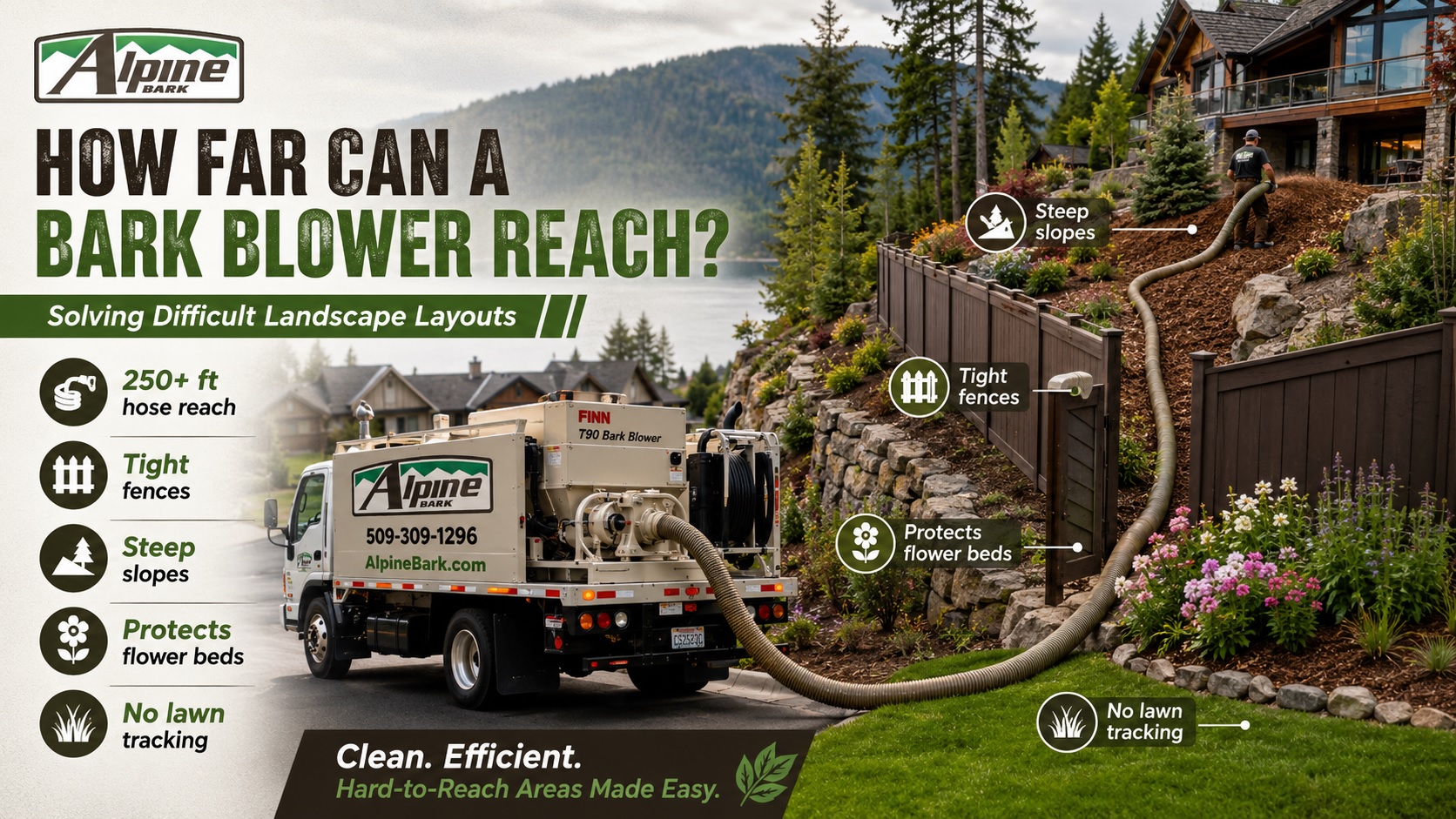
At Alpine Bark Blowing, we solve those layout challenges every day. Our professional bark blowing process uses pneumatic blower equipment and long commercial hose systems to install bark mulch quickly, cleanly, and efficiently without dragging wheelbarrows across the lawn or driving heavy equipment over finished landscapes. Alpine Bark Blowing notes that its truck carries more than 250 feet of hose, can reach difficult areas, and helps avoid lawn or plant damage from heavy equipment and wheelbarrows.
For Inland Northwest properties in Hauser, Coeur d’Alene, Post Falls, Hayden, Liberty Lake, Spokane Valley, Sandpoint, Spokane, and nearby areas, bark blowing is often the smartest way to handle complex landscapes.
How Far Can a Bark Blower Reach?
Alpine Bark Blowing carries 250 feet of hose on its trucks and can reach farther with advance notice when a project needs additional distance. The company’s FAQ specifically asks customers to share the distance needed so the crew can plan properly.
That reach matters for properties with:
- Long driveways
- Backyards with no truck access
- Fenced landscapes
- Steep slopes
- Tiered garden beds
- Waterfront lots
- Retaining walls
- Narrow side yards
- Commercial courtyards
- HOA common areas
- Planting beds behind patios, decks, and pools
Instead of dumping a bark pile in the driveway and carrying it by hand, the crew rolls out hose from the truck, starts at the farthest point, and works back toward the truck while applying the requested depth.
How Long-Distance Bark Blower Hose Systems Work
A bark blower truck uses pneumatic equipment to move bark mulch through a flexible hose. The material travels from the truck through the hose and is placed directly into landscape beds by the crew.
This setup gives the crew control over placement, depth, and cleanup. It also allows bark to move through spaces where traditional equipment would struggle.
A long-distance bark blowing setup can move around:
- Fences and gates
- Narrow side yards
- Stairs and terraces
- Rock walls
- Flower beds
- Retaining walls
- Pools and patios
- Mature trees
- Irrigation lines
- Outdoor living areas
- Sloped yards and hillsides
Why Bark Blowing Is Ideal for Difficult Landscape Layouts
Some yards are not designed for wheelbarrows. Others are too steep, too narrow, too delicate, or too finished for heavy equipment.
A professional bark blowing service helps solve problems such as:
- No direct truck access to the backyard
- Tight gates that block loaders or equipment
- Lawn areas that would be damaged by repeated wheelbarrow trips
- Steep slopes where hand spreading is unsafe
- Delicate flower beds that need careful placement
- Multi-level landscapes with steps and retaining walls
- Large commercial beds where manual labor takes too long
- Waterfront or hillside properties with limited access
Protecting Lawns From Tracking and Equipment Damage
One of the biggest advantages of bark blowing is what does not happen. The crew does not need to run wheelbarrows back and forth across the grass all day. Heavy loaders do not need to enter the yard. Bark piles do not need to sit in the driveway while material is moved by hand.
This helps protect:
- Turf areas
- Irrigation heads
- Edging
- Walkways
- Patios
- Plant roots
- Decorative rock borders
- Freshly planted beds
- Soft or wet ground
- Finished outdoor living spaces
Alpine Bark Blowing promotes bark blowing as a way to gain access to hard-to-reach areas while treading lightly with no damage to plants or lawns.
For homeowners who want bark delivered instead of blown in, Alpine also offers delivery and retail pickup, but bark blowing is often the best choice for properties where access and cleanup matter most.
Navigating Tight Fences and Narrow Side Yards
In many Inland Northwest neighborhoods, backyard access is limited by fences, side yards, landscaping, decks, sheds, or utility equipment. A bark blower hose can often snake through these spaces more easily than a wheelbarrow or machine.
This is especially helpful for:
- Backyard garden beds
- Courtyard spaces
- Side yard plantings
- Narrow access points
- Landscapes behind fences
- Homes with limited driveway access
- Properties with tight turns or stairs
The crew can stage from the truck, route the hose through the safest path, and place bark directly where it belongs.
Protecting Delicate Flower Beds
Hand spreading bark around delicate plants takes time and care. Wheelbarrows can compact soil, crush border plants, or spill material where it does not belong.
With bark blowing, trained crew members direct the material into beds and adjust placement as needed. Alpine Bark Blowing notes that its crew applies material to specified areas, maintains the approximate requested depth, and then uses leaf blowers to clean overspray from sidewalks, patios, decks, and the home.
This approach works well around:
- Perennial beds
- Shrub borders
- Native plantings
- Flower gardens
- Tree rings
- Foundation beds
- Commercial entrance beds
- HOA landscape areas
- Raised planters
Bark Blowing for Landscaping on a Steep Slope
Steep slopes are common around North Idaho and Eastern Washington, especially near lakes, ridgelines, wooded lots, and multi-tiered properties. Landscaping on a steep slope is challenging because material is hard to haul, hard to spread evenly, and easy to displace.
Bark blowing helps because the crew can apply mulch from the hose without pushing heavy loads uphill or downhill. This makes the process faster and safer while reducing disturbance to the slope.
For sloped landscapes, bark mulch can help:
- Cover exposed soil
- Reduce surface runoff impact
- Slow soil movement
- Protect plant roots
- Improve moisture retention
- Reduce weed pressure
- Add a finished look to difficult terrain
Alpine Bark Blowing also offers erosion-related blower work and notes that it can install compost in all types of terrain for projects such as highway construction, land remediation, and private landowner work.
How to Stop Soil Erosion on a Hill With Bark Mulch
Homeowners searching how to stop soil erosion on a hill often need a practical first layer of protection. Bark mulch does not replace engineered drainage, retaining walls, hydroseeding, erosion blankets, or professional slope stabilization when those are required, but it can help protect exposed soil in many landscape beds.
A proper bark layer can help by:
- Shielding soil from direct rain impact
- Slowing runoff across the surface
- Reducing soil splash
- Holding moisture near plant roots
- Supporting plant establishment
- Reducing weed competition
- Insulating roots from heat and cold
- Making steep beds look finished
For steep slopes, product choice, depth, plant coverage, and drainage all matter. A professional estimate helps determine whether bark blowing, compost blowing, additional planting, or another erosion strategy is the best fit.
Why Bark Mulch Works Well in the Inland Northwest
North Idaho and Eastern Washington properties deal with dry summer heat, winter freezes, steep terrain, wind, and varied soil conditions. Bark mulch helps protect landscapes through those seasonal swings.
Alpine Bark Blowing describes its bark mulch as 100% organic and designed for moisture retention, natural weed suppression, and long-lasting color.
For local landscapes, bark mulch can support:
- Moisture conservation during dry summers
- Root insulation during cold winters
- Cleaner curb appeal
- Natural weed suppression
- Soil protection on slopes
- Better garden bed definition
- A finished look around homes and businesses
What to Expect During a Bark Blowing Appointment
A good bark blowing project begins before the truck arrives. Alpine Bark Blowing’s process includes estimating, scheduling, confirmation, on-site application, cleanup, walkthrough, and follow-up.
1. Estimate the Project
The first step is figuring out how much material is needed. Alpine can provide a free estimate by measuring areas, showing samples, and helping choose the right product. Customers can also measure length, width, and depth to estimate cubic yards.
2. Schedule the Service
Once the product and quantity are clear, the team schedules the blowing service. Special access concerns should be mentioned at this stage, including steep slopes, narrow gates, pets, delicate beds, long hose distance, irrigation systems, or limited parking.
3. Prepare the Property
Before service, Alpine recommends shutting windows and doors because bark blowing can be loud and dusty. It is also helpful to turn off sprinklers the night before for better cleanup.
4. Install the Bark
The truck arrives with the order. The crew rolls out hose, usually begins at the farthest point, then works back toward the truck while applying material to the requested areas and depth.
5. Clean Up and Walk Through
After installation, the crew uses leaf blowers to clean overspray from sidewalks, patios, decks, and the house. A foreman then completes a walkthrough to confirm the finished project meets expectations.
How Much Bark Mulch Do Difficult Yards Need?
Yardage depends on square footage and depth. Alpine’s FAQ states that one cubic yard covers approximately:
- 324 square feet at 1 inch deep
- 162 square feet at 2 inches deep
- 108 square feet at 3 inches deep
- 81 square feet at 4 inches deep
- 54 square feet at 6 inches deep
For most landscape beds, a 2 to 3 inch depth is common. Steep slopes, erosion-prone areas, or refreshed beds may need specific recommendations based on existing material, plantings, and slope conditions.
Best Projects for Long-Reach Bark Blowing
Long-reach bark blowing is ideal for:
- Steep hillside beds
- Multi-tiered backyards
- Waterfront properties
- Homes with narrow side access
- Fenced backyards
- Commercial buildings
- HOA entries and common areas
- Large planting beds
- Parks and municipal spaces
- Properties with fragile turf
- Areas behind retaining walls
- Landscapes with mature trees and shrubs
If a yard looks difficult, that is often exactly where bark blowing performs best.
When to Choose Bark Blowing Instead of Hand Installation
Choose bark blowing when:
- The project is large
- Access is limited
- The yard has slopes
- A clean finish matters
- The lawn should not be tracked up
- Wheelbarrow labor would take too long
- The property has delicate planting beds
- The driveway cannot be blocked with a bark pile
- The owner wants professional depth and cleanup
Hand installation may still work for tiny areas or quick touchups. For complex yards, bark blowing saves time, protects the property, and delivers a cleaner result.
Local Bark Blowing Service in Idaho and Washington
Alpine Bark Blowing is based in Hauser, ID and serves Idaho and Washington communities throughout the Inland Northwest. The company lists service areas including Coeur d’Alene, Post Falls, Hayden, Liberty Lake, Greenacres, Spokane Valley, Spirit Lake, Sandpoint, Spokane, Mead, Colbert, Deer Park, and Airway Heights.
Whether the property has a steep hillside in North Idaho, a multi-level backyard in Spokane Valley, or a fenced garden in Post Falls, Alpine Bark Blowing has the equipment and crew experience to install bark where manual methods become difficult.
Difficult Yards Are Exactly What Bark Blowing Is Built For
A long distance from the driveway, a narrow gate, a steep slope, or a delicate landscape bed should not stop a project from getting finished. Bark blowing was designed for these challenges.
With commercial hose reach, careful crews, professional cleanup, and premium bark mulch, Alpine Bark Blowing helps homeowners, contractors, HOAs, and commercial property owners finish difficult landscape layouts without heavy equipment damage, weekend labor, or messy bark piles. Request a quote today!
FAQs About Bark Blowing Reach and Difficult Landscape Layouts
How far can a bark blower reach?
Alpine Bark Blowing carries 250 feet of hose on its trucks and can reach farther with advance notice. Customers should share the needed distance during scheduling so the crew can plan the right hose setup.
Can bark blowing reach a fenced backyard?
Yes. Bark blower hose can often be routed through gates, side yards, and tight access points, making it a strong option for fenced backyards and hard-to-reach beds.
Is bark blowing good for landscaping on a steep slope?
Yes. Bark blowing is well suited for steep slopes because material can be applied through a hose without pushing wheelbarrows uphill or driving equipment over the landscape.
How does bark mulch help stop soil erosion on a hill?
Bark mulch helps shield soil from rain impact, slow surface runoff, reduce soil movement, retain moisture, and protect plant roots. For severe erosion, professional drainage or stabilization may also be needed.
Will bark blowing damage lawns or flower beds?
Bark blowing helps reduce lawn damage because heavy equipment and repeated wheelbarrow trips are not needed across the property. Alpine also notes that its crew treads lightly with no damage to plants or lawns.
Does bark blowing make a mess?
Some overspray and dust can happen, but Alpine Bark Blowing includes cleanup after installation. The crew uses leaf blowers to clean patios, sidewalks, decks, and bark dust near the house.
Does Alpine Bark Blowing serve Spokane and Coeur d’Alene?
Yes. Alpine Bark Blowing serves areas across Idaho and Washington, including Coeur d’Alene, Post Falls, Hayden, Liberty Lake, Spokane Valley, Sandpoint, Spokane, and nearby Inland Northwest communities.